Swachh Bharat Mission (Grameen) · Phase II
Sanitation
and dignity
Water supply and sanitation are the same problem observed at two points. What a village does with water after use determines whether the water it draws remains safe to drink.
- Phase II period
- 2020–21 to 2026–27
- Objective
- Converting ODF villages to ODF Plus (Model) villages
- Villages declared ODF Plus (Model)
- 4,96,180 of 5,86,944, as at 10 February 2026
- Constitutional position
- Sanitation is a State subject
Water, sanitation,
public health, dignity
A village well and a village drain are not separate subjects. Waste water that pools in lanes, and solid waste that is dumped at the edge of a settlement, return to the aquifer the village draws on. A household tap does not deliver safe water if what happens downstream of it is uncontrolled.
This is the practical reason the Ministry of Jal Shakti holds rural drinking water and rural sanitation in the same department. It is also why the second phase of the sanitation mission is framed around waste management rather than around toilet construction alone.
The dignity dimension is not decorative either. Open defecation falls hardest on women and girls, for whom it imposes a constraint on when and where they can relieve themselves at all. Sanitation policy documents state this explicitly, and the safety and dignity of sanitation workers themselves has become a named strand of the annual national campaign.
What ODF Plus means
The terms are used loosely in public discussion. They are defined terms in the mission, and the difference between them is the whole content of the second phase.
ODF
Open defecation free. No person in the village defecates in the open — which in practice requires both that toilets exist and that they are used. This was the objective of the mission's first phase.
ODF Plus
The village sustains its open-defecation-free status and has arrangements in place for solid waste management, liquid waste management, or both. Sustaining the first status is as much of the work as adding the second.
ODF Plus (Model)
A village that sustains ODF status, has both solid and liquid waste management arrangements in place, and demonstrates visual cleanliness. This is the standard reported against in the figures below.
Swachh Bharat Mission (Grameen) Phase II runs from 2020–21 to 2026–27. Its stated aim is not only to construct the infrastructure needed to convert ODF villages into ODF Plus (Model) villages, but to achieve behavioural change so that better sanitation and hygiene practices are adopted and sustained.
Information, education and communication is treated as integral to the programme for that reason, with up to 5 per cent of total project funds permissible for communication and capacity building — up to 2 per cent at the central level and up to 3 per cent at State and district level.
Total villages
Declared ODF Plus (Model)
With solid waste management arrangements
With liquid waste management arrangements
As reported by States and UTs on the SBM(G) Integrated Management Information System as at 10 February 2026, tabled in the Lok Sabha on 12 February 2026.
The national figure
conceals wide variation
A national average of about 85 per cent is made up of States ranging from under 20 per cent to over 99 per cent. Because sanitation is a State subject, that spread is the most informative thing in the dataset.
| State | Total villages | ODF Plus (Model) | Share | With SWM | With LWM |
|---|---|---|---|---|---|
| Uttarakhand | 14,967 | 14,893 | 99.5% | 14,931 | 14,899 |
| Madhya Pradesh | 51,043 | 50,689 | 99.3% | 50,763 | 50,788 |
| Tamil Nadu | 11,739 | 11,604 | 98.8% | 11,620 | 11,609 |
| Uttar Pradesh | 96,174 | 94,155 | 97.9% | 94,274 | 94,715 |
| Rajasthan | 43,463 | 42,515 | 97.8% | 42,713 | 42,820 |
| Telangana | 9,773 | 9,547 | 97.7% | 9,588 | 9,571 |
| Odisha | 46,928 | 44,946 | 95.8% | 45,099 | 45,283 |
| Kerala | 1,435 | 1,372 | 95.6% | 1,381 | 1,377 |
| Chhattisgarh | 19,643 | 18,523 | 94.3% | 18,565 | 18,739 |
| Bihar | 37,138 | 34,990 | 94.2% | 35,326 | 35,536 |
| Assam | 25,368 | 23,704 | 93.4% | 24,240 | 25,109 |
| West Bengal | 38,343 | 34,473 | 89.9% | 35,705 | 36,670 |
| Haryana | 6,618 | 5,875 | 88.8% | 6,115 | 6,406 |
| Maharashtra | 40,247 | 34,703 | 86.2% | 35,670 | 38,401 |
| Himachal Pradesh | 17,618 | 14,539 | 82.5% | 15,201 | 15,965 |
| Gujarat | 17,973 | 13,955 | 77.6% | 17,159 | 17,045 |
| Andhra Pradesh | 15,995 | 11,625 | 72.7% | 15,971 | 11,898 |
| Karnataka | 26,484 | 12,525 | 47.3% | 26,405 | 13,466 |
| Jharkhand | 29,322 | 8,069 | 27.5% | 9,955 | 26,681 |
| Punjab | 11,977 | 2,295 | 19.2% | 4,305 | 10,023 |
| All States and UTs | 5,86,944 | 4,96,180 | 84.5% | 5,29,231 | 5,46,487 |
Scroll the table sideways to see every column
Selected States shown in descending order of ODF Plus (Model) share; the total row covers all States and Union Territories, including those not listed. SWM: solid waste management. LWM: liquid waste management. Share column computed from the two preceding columns. Source: Annexure to Lok Sabha Unstarred Question 2076, answered 12 February 2026 by the Minister of State for Jal Shakti, Shri V. Somanna.
Assessment and campaign, 2026
Swachh Seva Aankalan · 15 September 2026
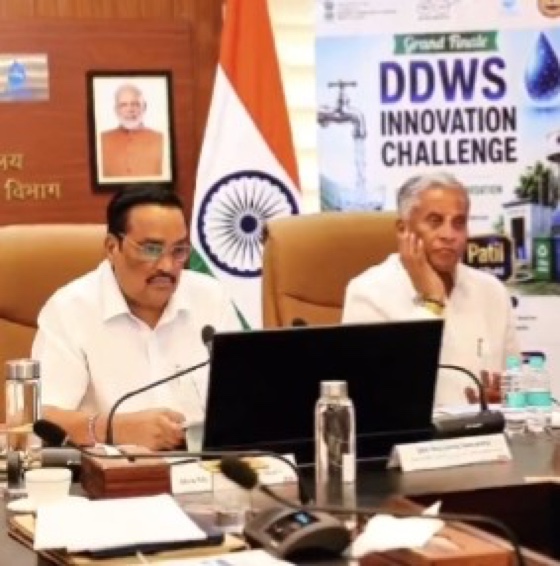
Launched by the Union Minister of Jal Shakti at a virtual meeting with States and Union Territories, attended by the Minister of State, Shri V. Somanna, along with State ministers in charge of rural sanitation and the Mission Directors of Swachh Bharat Mission (Grameen).
It is an annual, Gram Panchayat-level digital self-assessment framework for assessing and monitoring sanitation service delivery in rural areas. The multi-tier structure involves Gram Panchayats, Gram Sabhas, Village Water and Sanitation Committees, and district and State officials.
It is the sanitation counterpart of Jal Seva Aankalan on the drinking water side: both move monitoring from a central return to an assessment made at the level where the service is actually received.
Swachhata Hi Seva 2026 · from 17 September 2026
The annual national cleanliness campaign, running from 17 September to Swachh Bharat Diwas on 2 October, under the theme Swachhata Mein Sahbhag, Swachh Bharat, Viksit Bharat.
The campaign is organised around five stated pillars:
- Transformation of cleanliness target units and clean public places
- Swachh Paathshala: Yuva for Swachhata — schools, colleges and universities as hubs of the campaign
- Safai Mitra Suraksha Evam Samman Shivir — the safety and dignity of sanitation workers
- Jan Bhagidari for Swachhata — public participation
- Swachhata Se Samriddhi — linking cleanliness to livelihoods
Marked dates within the campaign include World Tourism Day on 27 September, focused on tourist and pilgrimage sites and public toilets, and a nationwide voluntary cleanliness drive on 1 October.
Sources and references
- Press Information Bureau, Ministry of Jal Shakti, Release ID 2226999, 12 February 2026 — Swachh Bharat Mission (Grameen) Phase II, with State-wise annexure as at 10 February 2026, reply to Lok Sabha Unstarred Question 2076 — pib.gov.in
- Department of Drinking Water and Sanitation, Swachh Bharat Mission (Grameen) — swachhbharatmission.ddws.gov.in
- Government announcements of the launch of Swachh Seva Aankalan on 15 September 2026 and of Swachhata Hi Seva 2026 from 17 September 2026
- SBM(G) Integrated Management Information System, the source of the State and UT returns reproduced above
Last updated: September 2026 · Coverage data as at 10 February 2026