1955 – 1989
Early life
and background
The first thirty-four years: a village in Jalgaon district, a trade certificate in Surat, fourteen years in a police constable's uniform, and then a decision to leave it.
- Born
- 16 March 1955, Pimpri Akarout, Jalgaon district, Maharashtra
- Trained at
- Industrial Training Institute, Surat
- Service
- Gujarat Police, from 1975
- Left for public life
- 1989
There is a particular kind of Indian political biography that begins not in a political family, a law faculty or a student union, but in a government service cadre at the lowest rung. This is one of them.
Chandrakant Raghunath Patil was born on 16 March 1955 in Pimpri Akarout, a village in Jalgaon district in the Khandesh region of northern Maharashtra. It is agricultural country, inland and dry, well away from the coastal belt of southern Gujarat where his career would later be made. His father, Raghunath Patil, was a police constable. His mother was Sarubai Patil.
The household was therefore a service household rather than a landed or professional one — a distinction that shaped what was available to him. A constable's salary in the 1950s and 1960s did not open the route to an English-medium education or a professional degree. It opened the route to a government job, and to the technical training that qualified a young man for one.
The Industrial Training Institute
ITIs were established across India from the 1950s under the Craftsmen Training Scheme to supply skilled trades to a newly industrialising economy. They award trade certificates, not degrees, and they were — and remain — the principal route into technical employment for students who do not continue to university.
His education was completed in Surat, at the Industrial Training Institute. This is the single educational qualification that appears in his Lok Sabha member record, and it is worth being precise about what it is, because it is frequently reported loosely.
An ITI certificate is a vocational trade qualification obtained over one to two years after schooling. It certifies a practical competence — fitting, electrical work, machining, and so on — and it is designed to lead directly into employment rather than into further study. No university degree appears in his published record, and none is claimed here.
Surat also fixed the geography of his life. Although born in Maharashtra, he grew up into adulthood in Gujarat, and every office he has since held — organisational, corporate, parliamentary and ministerial — has come through Gujarat. When he was made president of the state party unit in 2020, it was noted that he was the first person from outside the state to hold it.
Fourteen years
in uniform
In 1975 he joined the Gujarat Police as a constable. He was twenty. It was the rank his father had held, and it is the entry rank of the force — the level at which an officer does patrol duty, station work and public order, and at which the working relationship with the public is closest and least mediated.
He served for something in the order of a decade and a half before leaving for public life. It is worth pausing on what this means as preparation for the portfolio he now holds. A constable's daily experience of government is administrative and procedural: registers, jurisdictions, chains of command, complaints that are made at a counter rather than in a legislature. That is not an obvious training for national water policy, but it is a direct and prolonged exposure to the machinery through which policy actually reaches people.
A discrepancy, stated rather than resolved
Published accounts agree that he joined the Gujarat Police in 1975 as a constable. They do not agree on when that service ended. Some reference compilations give 1984; others give 1989, which would make the service continuous up to the year he joined the Bharatiya Janata Party.
Neither date could be confirmed against a primary Government of India record for this site. Rather than choose one and present it as settled, both are recorded here. Where a public figure's biography contains an unresolved point, saying so is more useful than smoothing it over.
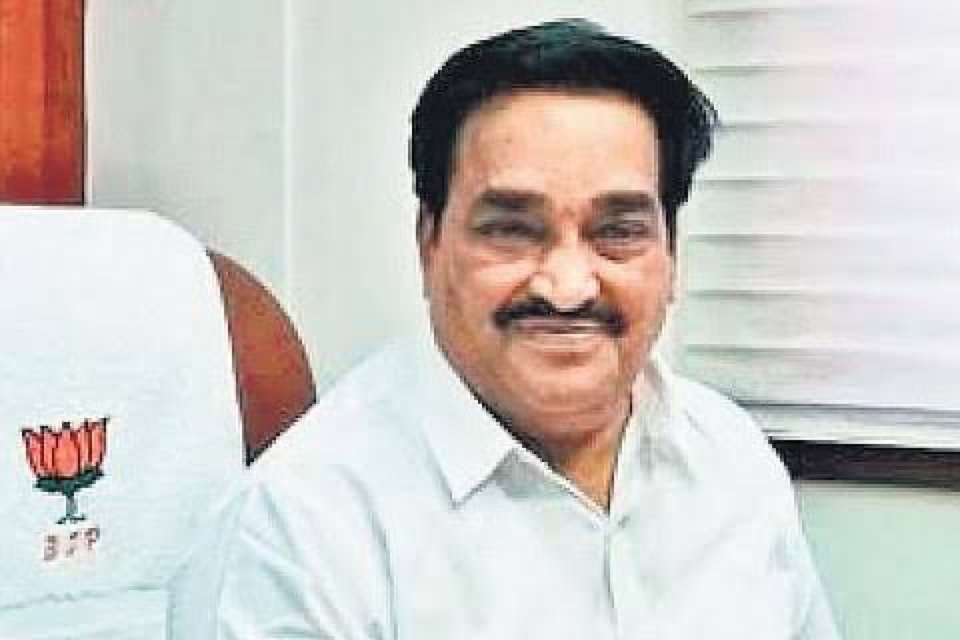
The move into public life
He joined the Bharatiya Janata Party in 1989 and began at city level in Surat. He did not enter through an elected seat, a student wing or a family connection; he entered through organisational work, and he stayed in it for two decades before ever standing for election.
The offices he held in that period were internal and administrative: treasurer of the Surat city unit, then vice-president. His first public appointment came in 1998, as Chairman of Gujarat Alkalies and Chemicals Limited, a state public sector undertaking; he also served on advisory committees attached to the Chief Minister of Gujarat and to the state's Revenue Ministry, and on the party's state parliamentary board.
He was fifty-four when he first contested an election, in 2009. By the standards of Indian public life that is a late start, and it means that the twenty years between 1989 and 2009 — the period least visible in any public record — account for the larger part of his political formation. What can be documented about those years is set out, with dates, on the political journey page.
Sources and references
- Lok Sabha member profile, Navsari (Member ID 4452), Parliament of India — sansad.in
- Published biographical reference compilations, used for dates of police service and party entry, and identified in the text where they conflict
- Directorate General of Training, Ministry of Skill Development and Entrepreneurship, on the Craftsmen Training Scheme and the role of Industrial Training Institutes
Last updated: September 2026